
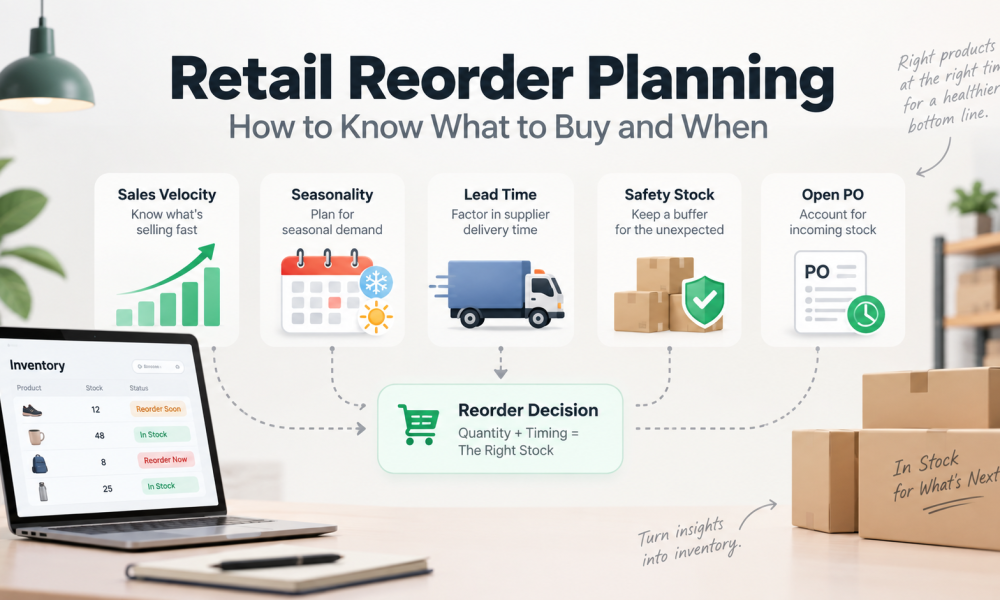
Reordering inventory is a balance. Buy too late and the business loses sales. Buy too much and cash becomes trapped in slow-moving stock. A practical replenishment process uses more than a simple “low stock” warning.
Reorder calculations are only as good as the inventory data behind them. Unrecorded receiving, missing transfers, incorrect returns, or disconnected ecommerce sales can make a mathematically correct recommendation operationally wrong.
Look at how quickly each product sells over a relevant period. Fast-moving items generally need more frequent review, while slow-moving products may not need replenishment even if their quantity appears low.
A product that sells ten units per week and arrives in two days requires a different reorder point from one that takes six weeks to receive. Lead time should reflect actual supplier performance, not only the promised date.
Safety stock protects against demand spikes and delivery delays, but excessive buffers create overstock. Higher-value or predictable items may justify a different safety-stock policy from inexpensive high-volume essentials.
Before creating another purchase, check open purchase orders and expected receipts. Otherwise staff can reorder the same shortage several times before the first shipment arrives.
Historical averages can be misleading for seasonal products. Holidays, weather, school calendars, promotions, local events, and product launches may require different replenishment assumptions.
For multi-location retailers, one branch may be overstocked while another needs replenishment. A transfer can sometimes solve the problem faster and more cheaply than another supplier order.
Reordering is not only about what to buy. It should also identify what not to buy. Slow-moving inventory may need markdowns, bundles, transfers, supplier returns, or a change in purchasing policy.
When purchasing, sales, ecommerce, transfers, and warehouse inventory are managed from connected data, replenishment decisions become easier to explain and improve. SalePro provides the operational records needed to support that process.
 arrow_upward