
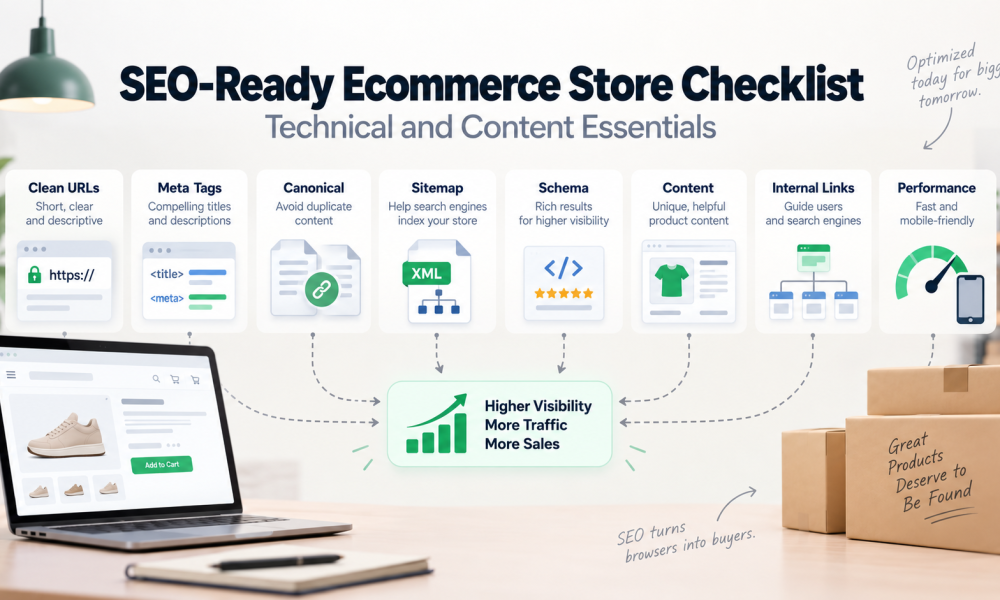
An ecommerce store can look excellent and still be difficult for search engines to understand. SEO readiness starts with technical foundations, but it also depends on useful product information, sensible site structure, and content that answers real customer questions.
Product, category, and article pages should have unique titles that describe the page clearly. Avoid filling titles with repeated keywords or using the same generic title across the whole store.
Meta descriptions do not replace page content, but they can summarize a page for search results. Write them for people, keep them specific, and avoid generating identical descriptions for hundreds of pages.
Short descriptive slugs are easier to understand than URLs dominated by internal IDs and unnecessary parameters. Product and category URLs should remain stable whenever possible.
Ecommerce sites often create multiple URLs that show similar content because of filters, sorting, tracking parameters, or alternate routes. Canonical tags can indicate the preferred version, but they should be implemented consistently with internal linking and indexing rules.
A sitemap helps search engines discover important products, categories, pages, and articles. It should contain canonical URLs that the business actually wants indexed rather than every possible filtered URL.
Product structured data can help search engines understand information such as product identity, offers, and availability when the markup accurately reflects the page. Article and breadcrumb structured data may also be useful for relevant content types.
Manufacturer descriptions copied across many stores rarely differentiate a page. Add details that help customers choose: dimensions, compatibility, use cases, materials, care, package contents, FAQs, or comparisons where relevant.
Categories, related products, buying guides, and blog posts can help users discover relevant pages and can clarify the relationship between content. Avoid creating orphan pages that are reachable only through search or a sitemap.
Search results, carts, account pages, checkout routes, and endless combinations of filters generally do not need to become search landing pages. Ecommerce SEO should prioritize pages that offer distinct value.
Fast loading, mobile usability, stable layouts, accessible navigation, and optimized images improve the experience for visitors. SEO works best when technical optimization supports a store that customers can actually use comfortably.
For SalePro ecommerce deployments, these practices can be incorporated into the storefront so merchants have a stronger technical base for building their own search visibility over time.
 arrow_upward